
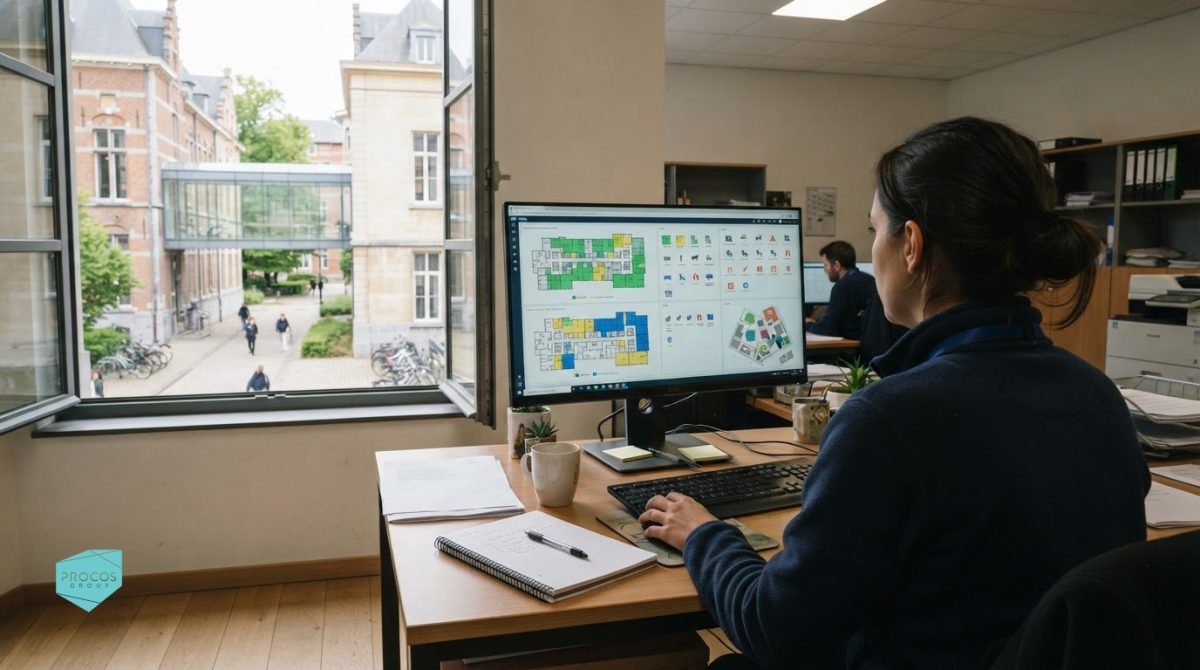
A campus requires coherence between buildings, spaces, assets, and facility processes. Smart campus management brings these components together in a unified approach, supported by software that consolidates data on space utilisation, maintenance, and operations.
On a campus, decisions regarding space and maintenance directly influence one another. When information is fragmented across disparate systems or teams, maintaining oversight of occupancy, costs, and operational requirements becomes difficult. Integrated management makes these interdependencies clear and helps align decisions with the day-to-day reality of the campus.
In this article, you will discover what a campus management solution encompasses and how integrated facility management and software help address campus challenges. We examine which data points support management decisions, where technology provides actionable insight, and which governance factors are critical during implementation.
Key Takeaways
- Consolidate data on buildings, spaces, assets, and facility processes to support coherent management decisions.
- Use data on space utilisation, available floor area, and costs to build a solid foundation for real estate decisions.
- Align software with maintenance workflows and service requests to minimise campus disruptions.
- Define which teams will use the solution and identify the precise information they require for operational and strategic decisions.
Integrated Campus Management and Facility Management
Integrated management connects buildings, spaces, assets, and facility processes within a unified operational framework. On campuses with near 24/7 activity, this cohesion helps bring information and operational responsibilities together.
System capabilities can encompass data on space utilisation, available floor area, operating costs, and maintenance. From a data governance and privacy perspective, clearly establish which data is processed, who has access, and how the information is used. Limit data collection strictly to what is necessary for the defined management processes.
In practice, a dashboard brings together space utilisation, maintenance records, and energy consumption. Implementation begins by scoping buildings, processes, and datasets, followed by system configuration and operational alignment with relevant teams. In Belgium, the defined scope determines which campuses and satellite locations fall within the management framework.
Comparison with Other Campus Management Systems
When evaluating campus management systems, compare how well they align with existing processes, data structures, and reporting requirements. A solution that treats space management and maintenance in silos provides a very different operational picture than a platform integrating both domains. Therefore, when evaluating smart campus management, identify which decisions the system must support, such as preventive maintenance scheduling or space capacity assessments. Align your choice with the daily workflows and reporting needs of operational teams.
Target Groups for Smart Campus Management
This approach suits organisations responsible for multiple buildings or complex facility processes across a campus site. Facility management teams utilise the data for maintenance and daily operational tracking; real estate and campus managers can incorporate space utilisation, energy consumption, and maintenance costs into portfolio decisions. When students and staff occupy multiple facilities, a shared operational overview allows planners to evaluate capacity alongside facility maintenance requirements. The required functionalities depend on specific roles, workflows, and governance structures within the organisation.
Benefits of Campus Management Software
For universities and educational institutions, a campus platform turns operational data into actionable intelligence for daily and strategic decision-making. Teams can track space occupancy and compare scheduled reservations with actual utilisation. This highlights where timetable planning deviates from practical usage.
This discrepancy has direct operational consequences. A reserved room that remains empty still consumes energy and generates facility costs. By comparing room bookings against measured occupancy, educational institutions can evaluate whether scheduling accurately reflects the actual needs of students and staff.
Smart Campus Tools monitor space utilisation across university campuses. With this data, institutions can assess whether learning spaces should be scheduled or managed differently. The system enables fact-based discussions between campus management, academic scheduling, and facility teams. Its overall value depends on reliable baseline data and clear governance around its use.
When selecting a platform, connect the intended benefits to concrete operational processes from the outset:
- Define the specific space and utilisation metrics that operational teams need.
- Integrate service requests and fault reporting directly into existing maintenance workflows.
- Incorporate energy consumption and occupancy metrics into booking evaluations.
- When evaluating a SaaS solution, assess how its integration capabilities and scalability fit the campus ecosystem.
Integrated campus management software is frequently delivered as a SaaS model, aiming to lower the total cost of ownership, accelerate deployment, and improve system scalability. The business case balances internal and external costs against financial and operational benefits, including staff and student satisfaction. If you would like to explore the potential application for your campus, discuss campus management with PROCOS Group.
Some campus buildings in the United States sit unused up to 65% of the time. This finding highlights why a campus platform should analyse room reservations alongside actual utilisation: not merely to label vacancy as an issue, but to pinpoint where planning assumptions and user behaviour diverge. This provides teams with an objective baseline to reassess space allocation and substantiate campus-wide real estate decisions.
Who Is Smart Campus Management Intended For?
An integrated management approach is particularly relevant for universities and educational institutions coordinating multiple buildings, diverse user groups, and complex facility operations. Examples include a campus combining educational spaces, administrative offices, and specialized technical facilities, each with distinct operational demands. This approach enables teams to coordinate decisions regarding space, maintenance, and facility utilisation effectively.
Scale can vary significantly. Mainz University of Applied Sciences operates across five urban campuses and serves approximately 5,500 students. This example demonstrates why campus managers require visibility across disparate locations without forcing every site into an identical operational model. Other large enterprise sites can similarly benefit from a shared governance and data framework.
Key stakeholders typically include campus management, facility management, corporate real estate, IT, and finance. Each role requires specific insights: facility management tracks maintenance workflows, real estate monitors space capacity, and finance evaluates the cost implications of operational choices. Students and employees actively use the buildings. Understanding their operational needs helps determine which spaces, services, and maintenance priorities should take precedence.
The initial phase involves defining the operational scope. Determine which locations, building typologies, and operational processes fall within the management perimeter. Next, establish data ownership, specify reporting requirements across departments, and clarify which decisions the platform must support. This process determines whether a single unified framework suffices or if specific campuses require tailored workflows. Site scale alone does not determine project suitability; process interdependencies and user requirements are equally decisive. To discuss your organisation’s requirements, contact PROCOS Group.
This is especially critical for teams aligning space planning with portfolio decisions. Reserved campus space is not always occupied, which leads to avoidable energy consumption and operational costs. Objective insight into actual space utilisation provides the foundation needed to evaluate real estate capacity accurately.
A campus real estate dashboard can integrate actual space utilisation, operational costs, and available floor area. This enables campus management, real estate, and finance teams to rely on a single source of truth when evaluating space and facility investments.
PROCOS Group
PROCOS Group helps organisations translate their campus management requirements into structured choices regarding processes, governance, and software. When multiple departments are involved or data remains fragmented across disconnected systems, a Facility Management Audit establishes an objective baseline of existing operations and identifies areas for improvement.
Subsequently, a tailored Workplace Strategy aligns spatial requirements with organisational objectives. PROCOS Group advises organisations on evaluating and deploying appropriate digital platforms, such as Archibus or Facile. The optimal approach depends on the operational workflows, reporting needs, and strategic decisions your organisation aims to support. A structured implementation framework also addresses governance and user adoption, ensuring the technology supports day-to-day operations effectively.
Would you like to discuss the campus management challenges within your organisation? Contact PROCOS Group.
Translate Campus Management into a Concrete Next Step
Adopting smart campus management starts with identifying the specific decisions your organisation aims to improve. Determine which operational bottlenecks carry the greatest impact and which departments must collaborate to resolve them. This gives subsequent initiatives a structured direction, maintaining focus on processes, governance, and the actionable data that underpins decision-making.
Next, define what measurable success looks like for your campus. This could involve improved cross-departmental alignment, robust data for portfolio decisions, or standardisation across facility workflows. By defining objectives and governance roles early in the process, prioritising initiatives and embedding long-term operational improvements becomes much more manageable.
A clearly defined first step provides your organisation with a solid foundation to develop its campus management approach effectively.